


There’s a pattern I’ve been thinking a lot about lately, one that a board-certified orthopedic surgeon named Dr. Howard Luks describes after 30 years of watching it happen to his patients. He calls it the slow shrinking of what your body allows you to do; or more precisely, what you assume your body can still do at your age.
It goes like this. You used to carry four grocery bags in one trip. Now you take two. You used to sit on the floor with the grandkids. Now you quietly migrate to the couch. Nobody decides to make these changes. Your body loses a little capacity, your daily habits quietly adjust to that loss, and before long, the smaller version of your life becomes the new normal. You’ve accepted less without ever meaning to.
Dr. Luks calls this “the narrowing.” I think of it as life shrinking around us, one small accommodation at a time.
Here’s the thing: most of that shrinking is not inevitable. And that is genuinely wonderful news.
Understand What’s Actually Happening
 Yes, some physical changes as we get older are real and unavoidable. Aerobic capacity (what scientists call VO2 max) declines roughly 10% per decade in people who aren’t training. Muscle strength gradually decreases after 50, and interestingly, explosive power declines at roughly twice the rate of strength; those fast-twitch fibres that help us catch ourselves from a stumble or spring up from a chair are the first to go when we stop using them.
But here’s what the science also tells us, and what almost nobody’s doctor mentions: these declines are profoundly modifiable. There’s a crucial difference between the sedentary decline curve and the human decline curve. The sedentary one is steep. The trained one is a much gentler slope. Well-trained adults in their seventies routinely outperform untrained adults in their fifties. That’s not a motivational poster; it’s one of the most consistently replicated findings in the entire field of aging research.
So when someone says “that’s just what happens at my age,” they’re actually describing what happens when we stop. The body isn’t following a fixed schedule; it’s responding to what we ask of it.
Reverse the Loop Before It Tightens
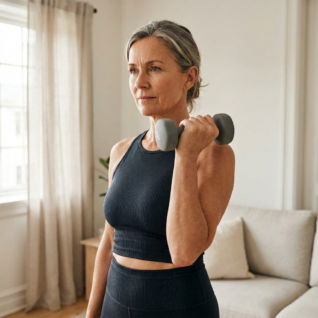 Once the shrinking starts, it tends to accelerate on its own; and that’s the part worth paying attention to. You stop lifting heavy things. Your muscles lose fast-twitch fibres. You get a little weaker. So you lift even less. You lose a little more. The loss starts to feel like aging, which makes it feel inevitable, which makes you less likely to challenge it. The loop tightens.
The good news is that the loop runs in the other direction, too. When you start asking your body to do something again, it responds. It rebuilds. This is true well into your seventies and eighties. The body does not stop being trainable; it simply needs to be asked.
This is exactly why resistance training matters so much as we age. In my BodySculpt classes, we work with weights and resistance in a way that challenges your muscles progressively. That progressive load is the signal your body needs to maintain strength, hold onto bone density, and keep those fast-twitch fibres firing. You don’t need to lift like an athlete; you just need to lift consistently, and with a bit of intention behind it.
Don’t Mistake Disuse for Decline
 Dr. Luks makes a distinction that I think is important for all of us to hear: the unavoidable decline of aging is only a small fraction of what most people actually lose. The bigger portion; the part that can turn a capable sixty-year-old into a frail seventy-year-old, is not aging.
It’s disuse.
This matters enormously, because disuse is reversible. If you’ve stopped sitting on the floor, stopped carrying things, stopped moving in the ranges of motion you used to use, you can gently start doing those things again, and your body will begin to come back to meet you. This is also why Mobility work is so important alongside strength training. In my Mobility classes, we work on restoring the joint range and movement quality that makes daily life feel effortless; not just stretching, but building the active control to use that range confidently. Mobility is what allows you to get down on the floor; strength is what gets you back up again. You need both.
Start Where You Are, Not Where You Were
 One of the things I love most about what Dr. Luks writes is this: the people who reverse the shrinking are not the ones with the best genetics, the best joints, or the most ideal circumstances. They’re the ones who simply decided to do something. Something made them stop accepting the losses as inevitable.
You don’t need to overhaul your life overnight. Starting where you are is not just acceptable; it’s the right strategy. Three or four classes a week, in your living room, on your own schedule. A BodySculpt session here, a Mobility class there, a Yoga or Pilates session when you want something a little gentler. It all counts, and it all adds up in ways that are visible over time. The library is full of options at every level, for every kind of day.
Dr. Luks himself, now in his early sixties, trains with intention every week. He does this not because he is chasing his younger self, but because he watched that freight train of decline coming from decades away and decided not to be on the tracks. “The door you thought had closed,” he writes, “is usually still open.”
I believe that. And I hope you do too.
Keep the Door Open
Life does not have to get smaller as we get older. Yes, some change is real; but the science is clear that much of what we accept as “just aging” is actually the consequence of doing less. And doing less is something we can change, at any age, starting right now.
The prescription isn’t complicated: move consistently, challenge your muscles, work on your mobility, and give your body the signal that it is still needed and still capable. Because it is. The active, capable version of you hasn’t gone anywhere; it’s just waiting to be asked.
For More Information
- Luks, H. J. (2026). The Midlife Athlete’s Playbook. Substack: Built to Move, Born to Heal.
https://howardluksmd.substack.com/p/the-midlife-athletes-playbook- Healthspan. (2026). The real reason VO₂ max declines with age, and why it changes how you should train.
https://www.gethealthspan.com/research/article/why-vo2-max-declines-with-age- Lexell, J., & Downham, D. Y. (2021). Age-related changes in skeletal muscle. An overview of the prevalence, magnitude, and causes of muscle loss. PMC / NCBI.
https://pmc.ncbi.nlm.nih.gov/articles/PMC3060646/- Frontiers in Physiology. (2021). Responses to maximal strength training in different age and gender groups.
https://www.frontiersin.org/journals/physiology/articles/10.3389/fphys.2021.636972/full
0 Comments