


Let’s talk about something that doesn’t come up very often in fitness circles, but probably should. I’m going to say two words, and I want you to take a breath and stay with me: pelvic floor.
I know. For a lot of people, even hearing that term can feel a little awkward. It’s the kind of subject that gets quietly glossed over, even though every single one of us has these muscles and uses them every day without thinking about it. And here’s the thing: ignoring them doesn’t make them stronger.
The good news is, you don’t need to be embarrassed, and you don’t need to know a lot of anatomy. You just need to understand why they matter, and what you can do about it.
What Exactly Is the Pelvic Floor?
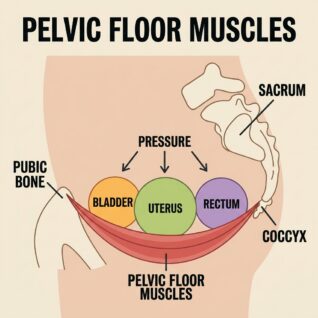 Picture a hammock of muscle and tissue that stretches from your pubic bone at the front of your pelvis all the way back to your tailbone. That’s your pelvic floor. It sits at the base of your core, quietly holding your bladder, bowel, and (for women) the uterus in place.
It also controls something we all care about: whether we make it to the bathroom in time. When you’ve ever had to quickly “hold it” or felt a little leak when you sneezed or laughed too hard, that’s your pelvic floor at work, or perhaps not working quite as well as it could be. These muscles are also deeply involved in posture, core stability, and sexual health, for both men and women.
The pelvic floor isn’t a “women’s issue.” It’s a human issue, and as we get older, it deserves our attention.
The “Stop the Flow” Test: Finding Your Pelvic Floor
 You’ve probably heard that the easiest way to locate these muscles is to imagine you’re stopping the flow of urine midstream. That pull and lift you feel? That’s your pelvic floor contracting. (To be clear: don’t actually practise this while urinating regularly; it’s just a way of identifying the right muscles.)
The key is learning to engage these muscles with a gentle lift and squeeze rather than a “bear down” or a bracing of your belly. Think “lift and hold” rather than “push.” Once you can find them, you can practise engaging them almost anywhere: sitting at your desk, standing in line, or especially during a workout.
Why These Muscles Weaken (And Why It’s Not Your Fault)
 A number of things can weaken the pelvic floor over time, and most of them are simply part of life. Pregnancy and childbirth, hormonal changes around menopause, carrying extra weight, chronic coughing, and even just the natural passage of time can all reduce the strength and responsiveness of these muscles.
The result can be leaking a little urine when you cough, sneeze, or exercise; a frequent or urgent need to use the bathroom; or a general sense that your “core” just isn’t holding things together the way it used to. Sound familiar? You are definitely not alone; this affects a huge number of active, healthy people.
The important thing to know is that weakness here is not inevitable, and it is certainly not permanent.
Simple Exercises That Actually Help
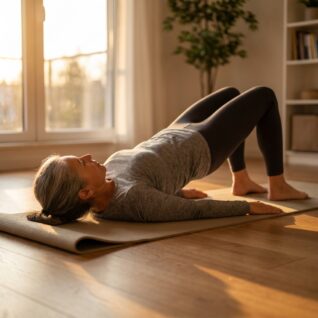 Pelvic floor exercises — often called Kegels — are the foundation. Here’s a simple starting point:
Sit or lie comfortably. Gently lift and squeeze your pelvic floor muscles (use that “stop the flow” sensation as your guide), hold for three seconds, then release for three seconds. Aim for ten repetitions, three times a day. Over the following weeks, try to work up to holding for ten seconds at a time.
The key word is gentle. This isn’t about gripping with everything you’ve got; it’s about controlled, deliberate contractions. Equally important is the release: fully letting go after each contraction is just as critical as the squeeze itself. Overly tight pelvic floor muscles can cause their own set of problems, so quality and relaxation matter as much as strength.
In my Pilates classes, we incorporate pelvic floor awareness regularly; it’s one of the foundational principles of Pilates movement, and it’s one of the reasons so many members find it transformative. If you haven’t explored the Pilates sessions in the library yet, this might be a perfect reason to start.
It’s Part of Your Core, Not Separate From It
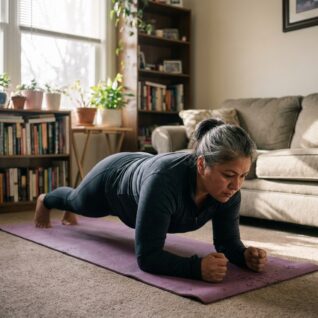 Here’s something that surprises a lot of people: the pelvic floor doesn’t work in isolation. It’s part of a cylinder of muscle that includes your deep abdominals wrapping around the front and sides, your spinal muscles at the back, and your diaphragm forming the top. Together, these create a strong, pressurised canister that stabilises your spine and protects your joints with every move you make.
When you engage your pelvic floor during movement, you’re not just protecting your bladder; you’re contributing to spinal stability, better posture, and safer lifting. In fact, every time we cue a gentle core engagement in BodySculpt or Pilates, the pelvic floor is part of that picture, whether we say so explicitly or not.
This is why building body awareness around these muscles pays dividends well beyond the bathroom. It supports your joints, your balance, and your ability to move with confidence.
Your Foundation Matters
The pelvic floor is one of those quiet, underappreciated parts of the body that does an enormous amount of work without ever asking for recognition. But giving it just a few minutes of thoughtful attention each day can make a real difference in how you feel, how you move, and how confident you are in your body. No gym required, no equipment needed; just a little awareness and a gentle, consistent effort. That’s something all of us can manage, and your body will absolutely thank you for it.
FOR MORE INFORMATION
- Harvard Health Publishing: “Pelvic floor exercises: Help for incontinence, sexual health, and more”
- Harvard Health Publishing: “Not just for women: Kegel exercises good for men too”
- Mayo Clinic: “Kegel exercises for women: A how-to guide”
- Mayo Clinic: “Kegel exercises for men: Understand the benefits”
- National Institute of Diabetes and Digestive and Kidney Diseases (NIDDK): “Kegel Exercises”
- Cleveland Clinic: “Kegel Exercises: Benefits, How To & Results”

0 Comments