

If you’ve ever hit a wall around two in the afternoon, you’re not alone.That slump you feel is something common to almost all humans; it’s biology.
Charles and I nap almost every day, and for a long time I assumed it meant we weren’t getting enough sleep at night. Turns out, we’re in excellent company, both scientifically and historically. This week let’s talk about why that afternoon dip happens, what a nap actually does inside your body, and why so many cultures around the world have built it right into their day.
The 2pm Slump Is Real (and It’s Not About Lunch)
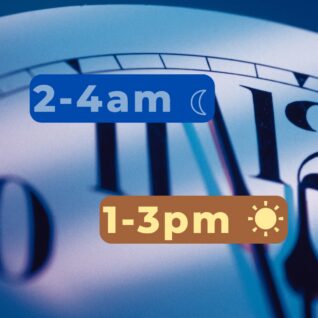 We all have an internal clock, our circadian rhythm, that governs when we feel alert and when we feel drowsy over a 24-hour cycle. What surprised me when I researched this is that most of us actually have two dips in alertness each day: one overnight between roughly 2 and 4am, and a second, smaller one in the early afternoon, typically between 1 and 3pm.
Here’s the part that really changes how I think about it: researchers have found this “post-lunch dip” happens even in people who skip lunch entirely, and even when they don’t know what time it is.¹ In other words, it’s not the sandwich making you sleepy; it’s your biology on a predictable, built-in schedule. A heavy or high-sugar meal can make the dip feel worse, but it isn’t the root cause.² So if you feel your energy drop mid-afternoon, that’s not laziness, that’s your circadian rhythm doing exactly what it’s designed to do.
Naps Can Help Clear the Day’s Stress Hormones
 When we don’t get enough overnight sleep, our bodies run a little hot on stress chemistry – specifically cortisol and norepinephrine, our main “fight or flight” hormones. In a well-known study, adults who were sleep-deprived and then allowed two short daytime naps saw their norepinephrine levels drop back down to nearly the same levels as people who’d had a full night’s sleep, along with improvements in a marker of inflammation.³ A separate study on brief naps during a stressful task found they measurably improved people’s mood and reduced negative feelings afterward.⁴
Over time, less circulating stress hormone is a genuinely good thing for your heart, your blood pressure, and your overall sense of calm. It’s one of the reasons short, regular naps have been linked to better cardiovascular outcomes in several long-term studies.⁵
Napping Is Older Than Any of Us
 Long before sleep science existed, entire cultures had already figured this out. The Spanish siesta, the Italian riposo, and the midday rest traditions still practiced in parts of Greece, Italy, India, the Philippines, and Latin America all line up neatly with that natural early-afternoon dip in alertness.⁶ Ancient Chinese medical texts described napping as a way to restore balance to the body, and it was considered an important health practice in Hellenic Greece and ancient Rome as well.⁵ This isn’t a modern wellness trend; it’s one of the oldest health habits we have, and it happens to line up perfectly with what our biology has been asking for the whole time.
The 20 to 30 Minute Sweet Spot
 Here’s where timing matters. NASA famously studied long-haul pilots and found that a 26-minute nap improved their alertness by over 50 percent and their performance by about a third, without leaving them groggy afterward.⁷ That’s the sweet spot: short enough to avoid what’s called sleep inertia, that foggy, disoriented feeling you get waking from a longer, deeper sleep cycle.
This matters more as we get older. While a quick nap a couple of times a week is associated with real cardiovascular benefits, research has found that regularly napping for an hour or longer is linked to higher blood pressure, less stable blood sugar, and other markers of metabolic strain in older adults.⁸ So the goal isn’t to sleep for as long as possible, it’s to nap smart: early afternoon, 20 to 30 minutes, done.
No Time to Nap? Give Yourself a Different Kind of Reset
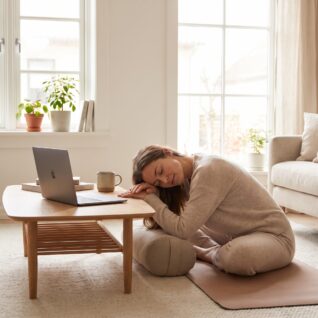 I get it, not everyone can nap, whether it’s a work schedule, family, or a household that doesn’t stop at 2pm. If that’s you, don’t feel like you’re missing out entirely. A short, quiet wind-down still tells your nervous system it’s allowed to settle: ten minutes of slow breathing, a short restorative stretch, or one of the gentler videos in the on-demand library can take the edge off that circadian dip even without actual sleep. It’s not a perfect substitute, but it’s a real one.
Give Your Afternoon Slump Some Respect
The next time your energy dips mid-afternoon, know that it isn’t a sign you’re falling behind; it’s your circadian rhythm working exactly the way it’s supposed to. A short 20 to 30 minute nap in the early afternoon can help clear lingering stress hormones, sharpen your focus for the rest of the day, and may even support your long-term heart health. Cultures around the world have known this for centuries, and now the research backs them up. If your schedule allows it, give yourself permission to lie down for twenty minutes; if it doesn’t, a short, quiet reset is still worth its weight. Either way, you’ll likely come back to the rest of your day feeling like a better version of yourself.
For More Information
¹ Sleep Foundation Why You Get Sleepy After Eating
² Same source as above
³ American Journal of Physiology-Endocrinology and Metabolism Daytime napping
⁴ Journal of Sleep Research A brief nap during an acute stressor improves negative affect
⁵ UCLA Health, Ask the Doctors Short naps may prove beneficial for cardiovascular health
⁶ The Conversation Short naps can improve memory, increase productivity, reduce stress and promote a healthier heart.
⁷ Sleep Foundation NASA Nap: How to Power Nap Like an Astronaut
⁸ Same as note 6

0 Comments