


Working in the garden might seem like a gentle way to spend a few hours, but it can actually be pretty rough on your body. Believe me, I know (and so does Charles)!
Trouble is, many of us just grab the gloves and get right into it — twisting our spines and gripping our hand tools for hours, then wondering why our wrists ache and our backs complain.
It doesn’t have to be this way. The most common gardening injuries — lower back strain, “weeder’s wrist,” shoulder tendinitis — are almost entirely preventable. Here’s how to do what you love without paying for it the next morning.
TIP 1 – Warm Up First

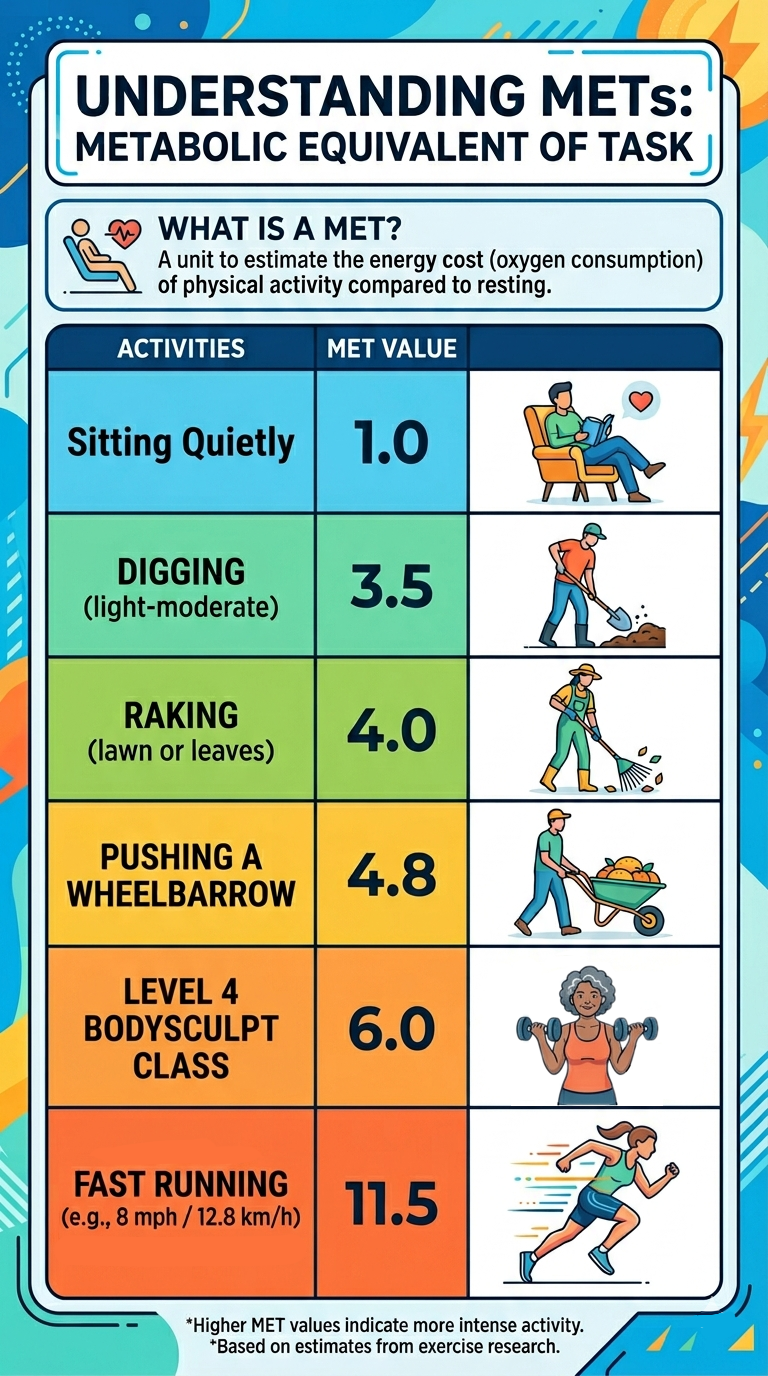
We always start BodySculpt class with a warm up, to prepare your muscles and joints for the work ahead. Gardening should be no different. Many gardening activities are considered moderate-to-vigorous exercise, based on their MET, or metabolic equivalent (see infographic below). So jumping in cold without a proper warmup dramatically increases your injury risk.
Before putting on the gardening gloves, spend five to ten minutes on light dynamic mobility movement to get blood flowing and joints lubricated: a brisk walk, shoulder rolls, hip circles, and gentle torso rotations. Click here to watch my recent 20-minute Mobility video, Warm Up For Gardening.
And don’t forget to hydrate! The discs in your spine are largely made of water. Well-hydrated discs stay plump and shock-absorbent. Dehydrated ones compress more easily, making even moderate bending and lifting harder on your spine.
TIP 2 – Work Within Your “Comfort Zone”
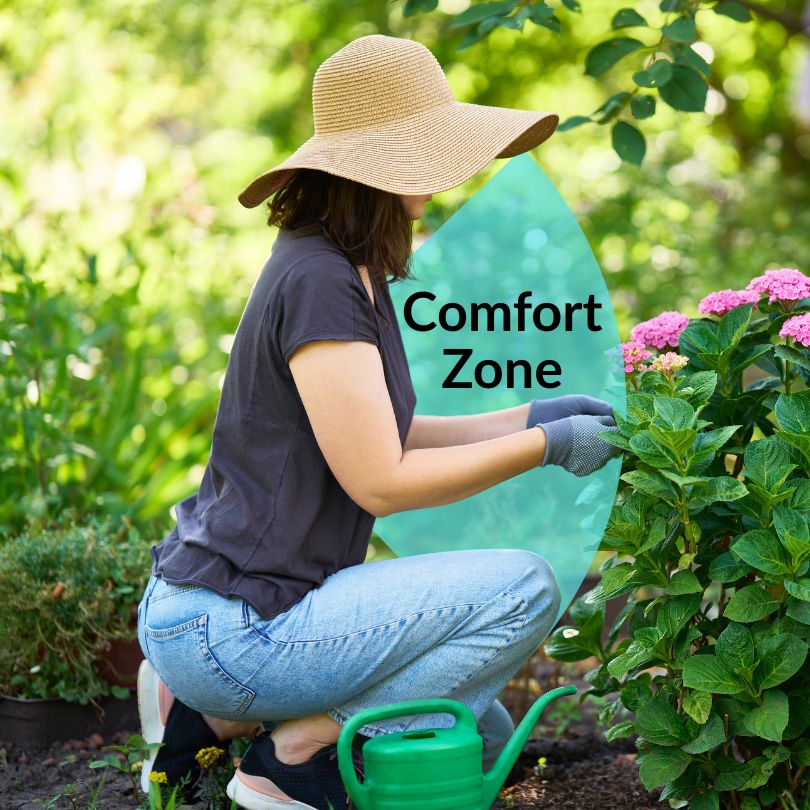
Think of your “comfort zone” as a roughly 12- to 18-inch bubble directly in front of your body. Reaching outside that zone — whether stretching for a weed or leaning sideways over a planter — forces your spine to round and puts serious leverage strain on your lower back, shoulders, and elbows.
To avoid this, stick to working within your “comfort zone” bubble.
Face your work head-on, too. Instead of twisting your torso sideways — one of the most common triggers for acute disc injuries — pivot your whole body by moving your feet so you’re always squared up to the task.
And when working close to the ground, skip the crouch or squat. Instead, kneel on a foam pad with one knee down and the opposite foot flat on the ground, which naturally stabilizes your pelvis and keeps your back upright.
TIP 3 – Rotate Tasks Every 20 to 30 Minutes

Repetitive strain injuries occur when you keep loading the same tendons, nerves, and muscle fibres with identical movements until micro-tears accumulate before you even feel any pain.
The fix is simple: switch what you’re doing every 20 to 30 minutes.
Move from a high-demand task like shovelling or raking to something lower-intensity and fine-motor — pruning, planting seedlings, or weeding. This allows fatigued tissues to clear out metabolic waste and begin recovering before real damage occurs.
Think of it like intervals in BodySculpt: push, rest, push, rest.
TIP 4 – Keep Wrists Straight and Let the Big Muscles Do the Work
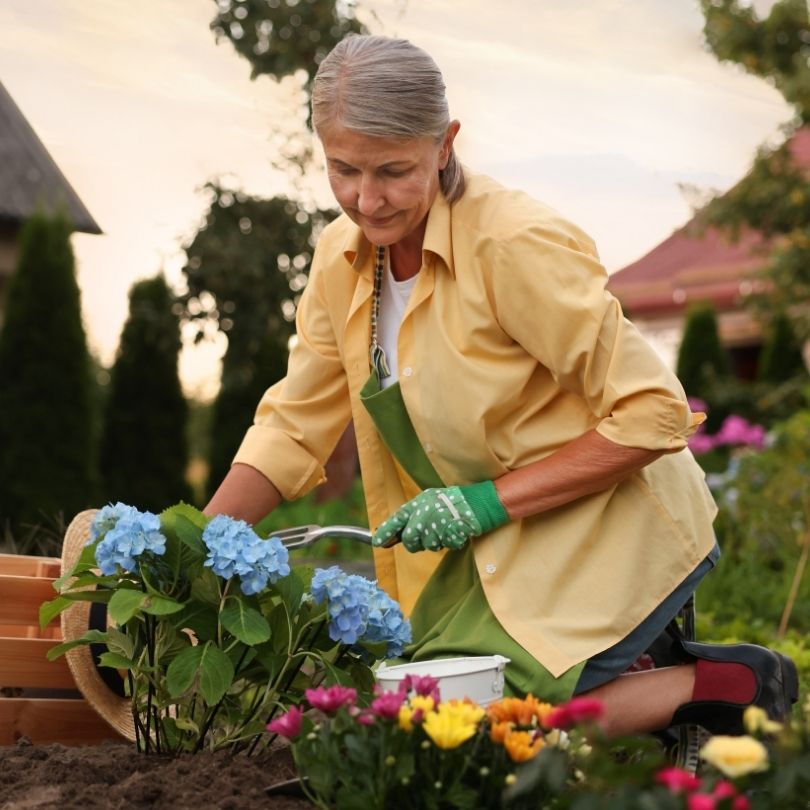
When you pull a stubborn weed or grip a heavy tool with a bent wrist, you’re asking small tendons and nerves to do a job they were never designed for at that angle. This can lead to tendinitis or carpal tunnel syndrome over time.
To avoid this, keep your wrist straight with your thumb pointing upward along the tool handle. And just as we do in BodySculpt, consciously engage your shoulders, biceps, and core when you pull or lift. Don’t rely on your hand grip alone. Your big muscles are designed for big work — let them lead.
Pro tip: If you’re shopping for tools, look for spring-assisted handles and padded grips. Also, tools with long handles reduce the need to bend as deeply, which will take strain off your lower back as a bonus.
Your Garden, Your Workout — Done Right
When it comes to working in the garden, it can be so tempting to skip the warm-up and just dig in – literally!
But before you start, remember these four tips:
- Work close to your body and face your task squarely.
- Rotate between demanding and gentle activities every 20 to 30 minutes.
- Keep your wrists neutral and let your larger muscles lead.
- Warm up like the athlete you are before you dig in.
These habits are the difference between a satisfying afternoon in the garden and a sore achy back or an unplanned rest day!
For more information:
Corliss, J. (2024, October 1). Gardening and yard work: Exercise with a purpose. Harvard Health Publishing, Harvard Medical School. https://www.health.harvard.edu/exercise-and-fitness/gardening-and-yard-work-exercise-with-a-purpose
Ebbert, J. (2021, June 17). Ergonomics for farm workers, gardeners. Mayo Clinic Community Health. https://communityhealth.mayoclinic.org/featured-stories/farm-garden-ergonomics


0 Comments