

This month, a 61-year-old grandmother from Welling, Alberta, held a plank for five straight hours at the Huntsman World Senior Games in Utah. In doing so, DonnaJean Wilde broke her own world record. That takes remarkable willpower, and it deserves recognition. As your coach, though, I want to be clear about what it is and what it isn’t.
Records measure endurance, not fitness
The record holder first discovered planks about 15 years ago, when she broke her arm and found she could plank with a cast on. Guinness measures how long a body stays straight with forearms and toes on the floor. That’s a test of endurance and grit. A fitness goal asks something different: what your muscles can do for you in daily life. A stopwatch can’t tell us whether the right muscles are doing their job.
Why more time can hurt
A plank changes as it goes on. Within a few minutes, the small stabilizers around your shoulder blades start to tire, and the bigger muscles in your back, hips and neck pick up the slack. That’s when the lower back arches, the neck strains and the elbows drift forward. When I looked closely at the attempt, I saw all three. That isn’t a criticism of DonnaJean, who has clearly put in the work. It’s a reminder that even a five-minute plank with sloppy form can do more harm than good, never mind five hours.
Who this really is for
Five hours is far beyond anything most of us would ever consider. You don’t need to plank for hours to get fitter. The goal with long endurance planks is usually recognition, a name in the record books, or proof of mental toughness. That’s a worthy accomplishment, and we honour it. It just isn’t a fitness accomplishment, and it shouldn’t be mistaken for one.
What to do instead
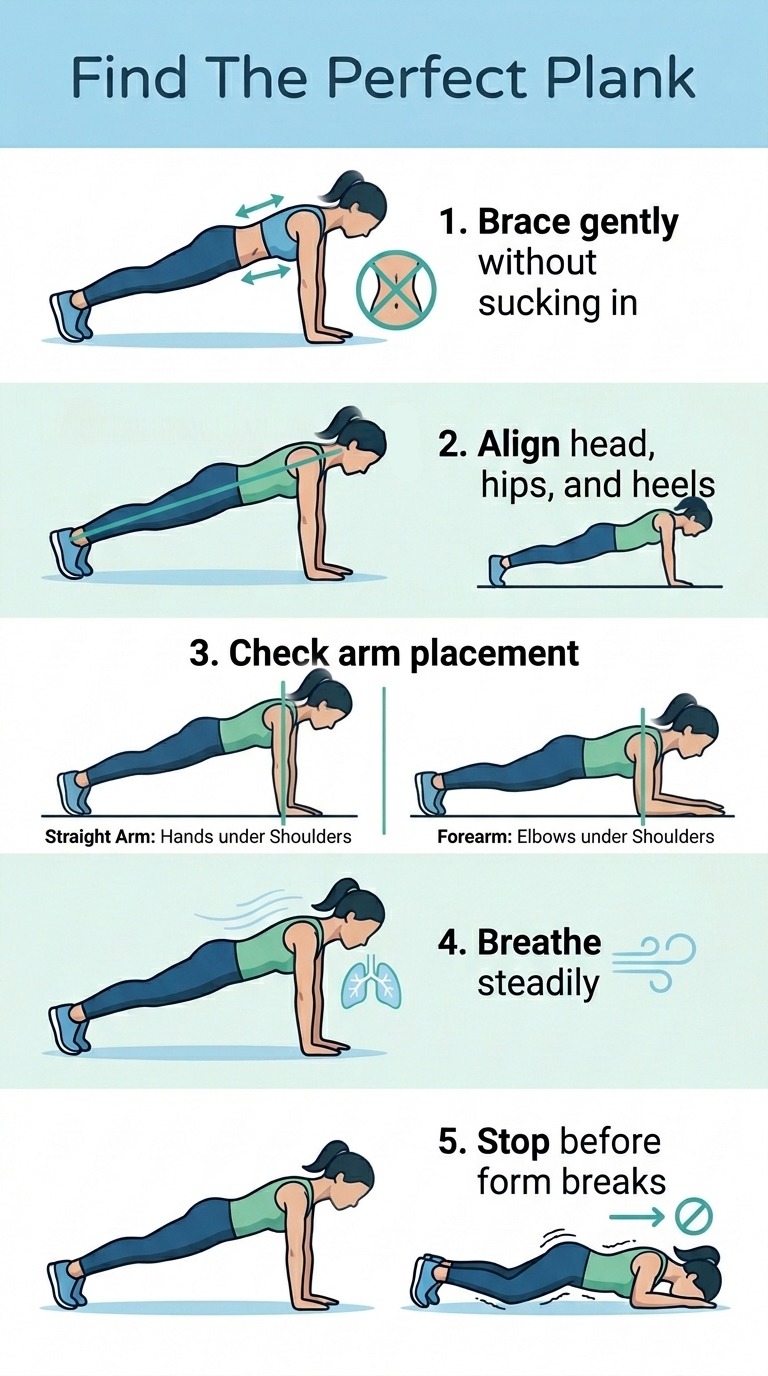
- Brace gently. Imagine a light nudge is coming, and let your deep abs engage without sucking in.
- Keep one line. Head, hips and heels should align, with hips level and your neck long, gazing just ahead of your hands.
- Check your base. Elbows sit under your shoulders, with your forearms firmly on the floor.
- Don’t hold your breath. Breathe steadily throughout. Holding it tenses everything and works against the controlled effort a good plank needs.
- Stop before the form breaks. Most adults can hold a plank for 20 to 60 seconds, according to Health magazine. Start there and build slowly.
Holding still also has real heart benefits. A 2023 review in the British Journal of Sports Medicine found isometric training among the most effective ways to lower blood pressure, with a commonly cited routine of four sets of two minutes, three or four days a week. Our BodySculpt classes build the strength to hold a solid plank, Pilates trains the deep control that keeps it steady, and Mobility keeps your shoulders, hips and spine moving freely.
The takeaway
Record holders are inspiring, and their stamina is impressive. But a strong, safe plank is measured by the muscles you engage and the position you hold, not the clock. Keep your holds short, keep your form honest, and let your body get stronger one solid plank at a time.
For More Information
- CBC News, “Alberta woman, 61, breaks her own world record by planking for 5 hours”: Link
- Health magazine, “How long should you be able to hold a plank?”: Link
- Mayo Clinic News Network, “Isometric exercise: Using body weight to lower blood pressure”: Link
- Geisinger, “Best exercise for high blood pressure”: Link

0 Comments